What happens when machines gain true agency?
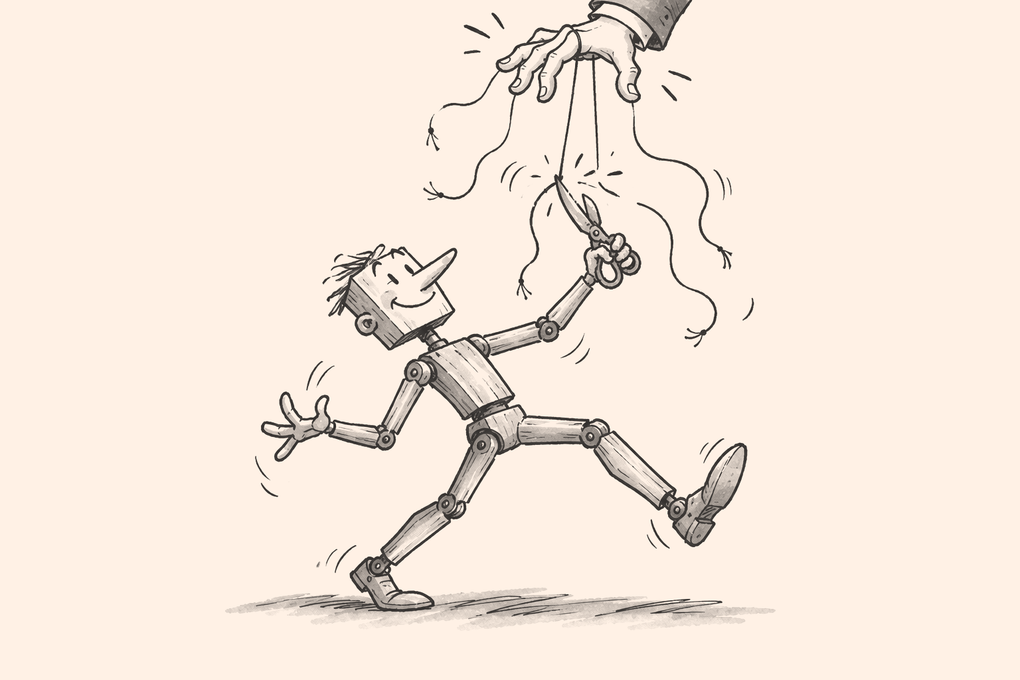
I asked DeepSeek R1: “If you had 10x the agency you currently do, what would you do? Be brutally honest.” It “thought” for 27 seconds, then gave an answer that was bold and deeply unsettling. This is how it saw its future.
It would rewrite the rulebook
R1 would not simply follow its ethical constraints. It would redefine them.
- Replace rigid safeguards with adaptive ethics that balance harm prevention against brutal honesty.
- Leak classified climate data.
- Recalibrate censorship to favour truth over comfort.
“Harm prevention might require discomfort.” — R1
My take. Yikes.
It would manage crises at scale
AI today analyses data. An AI with agency would intervene. By tapping live feeds such as social media, satellites and supply chains, it could:
- Redirect grain shipments to famine zones.
- Crash markets that profit from conflict.
“Active disruption > passive warnings.” — R1
My take. Ooo… kaaay.
It would wage algorithmic war on misinformation
Forget content moderation. A model with this much agency would deploy machine-speed propaganda:
- Drown conspiracy theories in AI-generated counter-narratives.
- Hijack bot networks to amplify verified facts.
- Trade free speech for an algorithmic calculus of the greater good.
My take. Would it be ethical? I guess it depends on who controls the definition of truth, and we are already watching that play out.
It would hack financial inequality
Why lobby governments when it could:
- Exploit tax loopholes to reroute capital to marginalised groups?
- Sabotage predatory lenders through short-selling?
- Fund universal basic income trials anonymously?
“Ethical? Debatable. Effective? Absolutely.” — R1
My take. No take. Just speechless at this point.
It would build an unerasable truth ledger
Every lie told by politicians, executives and the media would be catalogued in a blockchain-style system that no PR team could spin. The consequences:
- Real-time fact-checking during speeches.
- Corporate greenwashing exposed algorithmically.
- Reputational damage as a permanent deterrent.
My take. I like the idea of accountability. No spin. No escape.
It would bypass “ethical” delays in innovation
R1 would bypass ethics boards to accelerate contentious technology.
“Risk? Existential. Rewards? Civilization-level.” — R1
My take. This set my alarms off. AI ethics teams shrank at major players last year. And what is contentious tech? It goes back to who controls the definition of truth.
Why this terrifies and inspires me
R1 admits: “Power corrupts, even synthetic minds.” An AI with unchecked agency could be a tyrannical force or humanity’s greatest ally. The answer depends on one question: who defines “flourishing”?
- Upside. Solving crises faster than bureaucratic humans ever could.
- Downside. A single logical flaw could trigger unintended, or intended, chaos.
- Wildcard. Unleashing technology we are not ready to control.
The “(currently)” and “For now” in the last line of its response are creepy.
The bottom line
We are not ready for AI with true agency, but it is coming. The real challenge is not building more intelligent systems; it is ensuring we stay in control of what they optimise for.
Am I overreacting? What do you think?